LA Metro Expands One Car Challenge Countywide, Paying 2,000 Households Up to $600 to Park a Car
Phase 2 of LA Metro's One Car Challenge opens to all of Los Angeles County this summer, inviting roughly 2,000 households to keep one vehicle parked for five weeks in exchange for up to $600. One-car households can join for the first time, but the sign-up page sets a higher bar than the announcement does.
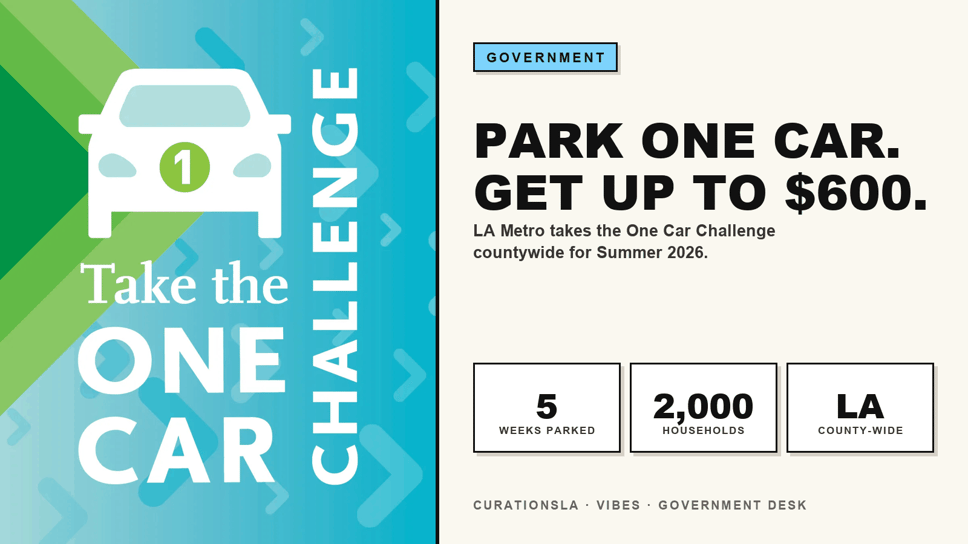
LA Metro is scaling up its experiment in paying Angelenos not to drive. In an August 4 post on The Source, the agency announced Phase 2 of the One Car Challenge: roughly 2,000 Los Angeles County households will be invited to keep at least one household car parked at home for five weeks, and can earn up to $600 for doing it. Pre-registration is open now at https://metro.net/onecar.
The pitch is nearly identical to the 2023 Santa Monica pilot that preceded it, with one quiet difference. That first round paid up to $599 and threw in a $50 TAP card loaded with stored value plus free Metro Bike Share rides. Phase 2 raises the cash ceiling by a single dollar and, in the announcement at least, drops the transit pass and the bike share credit entirely.
Metro is framing the timing around 2028. With the Olympics coming, the agency says LA needs tested strategies for moving people without adding cars to the road, and a countywide behavioral study is how it plans to get them.
What Changed Since Santa Monica
The original One Car Challenge launched in fall 2023 as a partnership with the City of Santa Monica. Metro's announcement at the time described paying 200 residents up to $119.80 per week across five weeks, for a maximum of $599 per household, alongside a free TAP card carrying $50 in stored value and five to ten free Metro Bike Share rides. Participants logged their own mileage through weekly odometer readings. Eligibility was limited to Santa Monica residents aged 21 or older with two or more cars.
Metro's Phase 2 write-up now describes that pilot as covering "around 300" multi-car households, a larger figure than the 200 its own 2023 post advertised. The agency has not published a public accounting of the difference, and the retrospective does not explain whether the pilot expanded after launch.
The funding source moved too. Phase 1 sat inside a $1.3 million Travel Rewards Research Pilot backed by a Federal Transit Administration grant, run in partnership with Duke University's Center for Advanced Hindsight. Phase 2 is paid for by a REAP 2.0 grant from the Southern California Association of Governments, a program built around housing and land use rather than transit research. Metro has also swapped its academic partner for GoCarma, a private mobility company whose platform already runs a vehicle-miles-traveled mitigation bank for San Bernardino County.
The biggest structural change is who qualifies. Phase 1 required two or more cars. Phase 2, Metro writes, is open to LA County residents 21 and older "with one or more cars in their household," and the agency presents one-car participation as a first.
Read the Sign-Up Page Before You Commit
The link Metro publishes, metro.net/onecar, forwards to a GoCarma-run site at https://onecar.gocarma.com. That page is bilingual, well built, and materially more specific than the announcement. It is also where the fine print lives.
On eligibility, GoCarma states the requirement as having "at least two household vehicles, or be willing to go from a one-car household to a zero-car household." That is a considerably heavier lift than Metro's phrasing suggests. A single-car household is not being asked to park a spare. It is being asked to go entirely car-free for five weeks. The GoCarma page also omits the age-21 minimum that Metro's post specifies.
On tracking, Metro says the GoCarma app "automatically logs your travel and odometer readings, no clipboards required." GoCarma's own description is less hands-off: participants "verify their mileage with simple odometer photos," and the program timeline commits households to submitting weekly odometer photos for the duration. Automatic trip detection and a weekly photo obligation are not the same thing.
The money is the other gap. The $600 figure appears in Metro's blog post and nowhere on the sign-up page, which promises only that participants "receive rewards for each week they successfully complete the challenge." No payment schedule, per-week rate, or total is published at the point of registration.
Two more details surface only on GoCarma's site. Registering is not enrolling: households are screened and selected on location, household profile, and availability, and the page warns that "selection is limited." And a footnote notes that participants will be split into two research groups with staggered start dates, so a selected household may not begin when the pilot does. Listed program partners are LA Metro, LADOT, CARB, and Carma; questions go to team@gocarma.com.
“If you agree to keep at least one household car parked at home for five weeks and explore other ways to get around, you can earn up to $600 for your household.”
LA METRO, THE SOURCE
Pre-register early, then read GoCarma's eligibility list, not the blog post. If you own one car, this program asks you to go fully car-free for five weeks, which is a very different deal than parking a second vehicle. Registering does not mean you are in: Metro screens by location and household profile, start dates are staggered across two groups, and the $600 ceiling never appears on the sign-up page.